Why Cat Urine Smells So Potent and Persistent
If you've ever dealt with a cat urinating on carpet, you'll know the smell is unlike anything else — sharp, piercing, and seemingly impossible to get rid of. The reason cat urine odour is so potent and persistent comes down to a unique combination of biology and the physical properties of carpet.
Understanding the science behind the smell is the first step to solving the problem for good.
The Biology: Why Cat Urine Is Especially Potent
Cat urine isn't simply watered-down waste. It's a complex, concentrated chemical cocktail that has evolved for communication and survival.
Extreme Concentration
Cats are desert-adapted animals, and their kidneys are highly efficient at conserving water. As a result, their urine is incredibly concentrated — far more so than human or dog urine. This means a higher density of odour-producing compounds per drop, which is why even a small accident can fill an entire room with smell.
Urea
Urea is the primary waste product in urine. When fresh, it has a relatively mild smell. But as it breaks down over time, it becomes the starting point for a cascade of increasingly unpleasant chemical reactions.
Uric Acid — The Real Villain
Uric acid is the compound that makes cat urine so notoriously difficult to remove. Unlike urea, uric acid is not water-soluble. It crystallises into hard, sticky salts that bind permanently to surfaces — carpet fibres, backing, padding, and even concrete. Regular cleaners, water, and even steam cannot fully break these crystals down.
Felinine
Felinine is a sulphur-containing amino acid breakdown product unique to cat urine — particularly in unneutered males. When it degrades, it produces the classic, piercing "cat pee" odour. This degradation process is accelerated by bacteria, which is why the smell often intensifies rather than fading over time.
Pet urine odour problems go deeper than you think
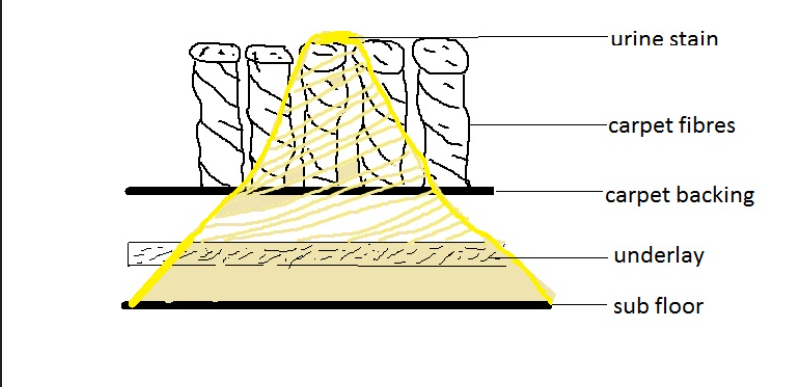
Problems travel far and wide!
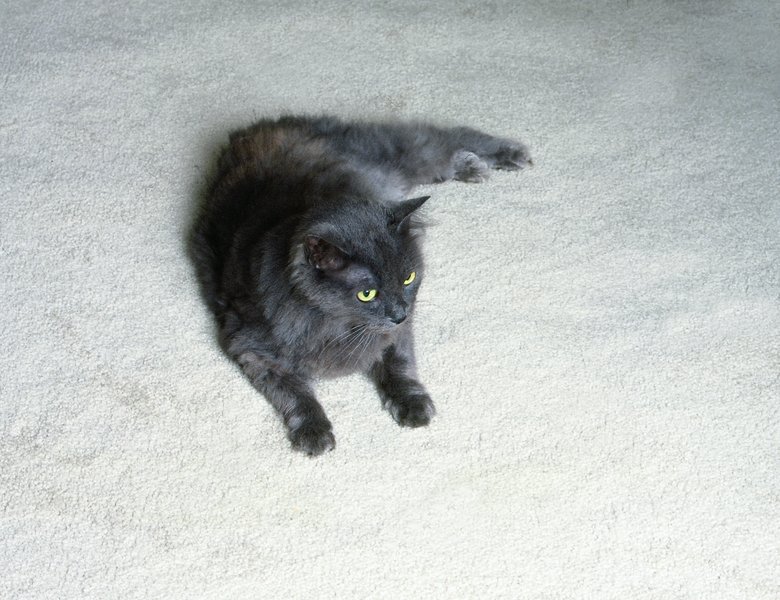
Even a small cat urine accident can penetrate through multiple layers of carpet — surface fibres, backing, and underlay — making professional treatment essential for permanent removal.
The Chemistry: How the Smell Gets Worse Over Time
The odour from cat urine isn't static — it undergoes a chemical transformation that makes it progressively more offensive if left untreated.
Bacterial Breakdown — Stage One
When urine soaks into carpet, bacteria from the environment begin breaking down urea into ammonia. This is why old cat urine smells sharper and more pungent than fresh urine — like a dirty litter box or a strong cleaning product. The longer the urine sits, the more ammonia accumulates.
Second-Stage Breakdown
Later, other bacteria break down the uric acid crystals. This releases thiols — the same volatile sulphur compounds found in skunk spray and rotting garlic — along with other volatile organic compounds (VOCs). This is the lingering, musky, sour smell that can haunt a home for months or even years after the original accident.
The smell from cat urine doesn't simply fade — it undergoes chemical changes that make it more offensive over time. Early professional treatment is always more effective than delayed action.
The Carpet Factor: Why It's the Worst Possible Surface
Carpet acts like a toxic sponge and incubation chamber for cat urine. Its layered structure makes the problem far worse than it would be on a hard floor.
Wicking and Deep Absorption
Carpet has multiple layers: surface fibres, a dense backing, and usually a separate underlay pad beneath. Urine doesn't sit on top — it wicks down through all these layers under gravity and capillary action. What you can smell on the surface is just a fraction of the problem. The underlay pad often holds the majority of the urine and is almost impossible to clean without professional equipment.
Trapped Crystals
The uric acid salts crystallise and embed themselves deep within the carpet fibres and padding. Every time humidity rises — from steam cleaning, warm weather, or even walking on the carpet — these crystals rehydrate and release odour anew. This is why the smell seems to come and go, and why it often returns after rain or on humid days.
A Perfect Bacterial Breeding Ground
The warm, dark, moist environment of a urine-soaked carpet pad is ideal for the bacteria that create the secondary, more offensive smells. Once established, these bacterial colonies are self-sustaining — they continue producing odour as long as the organic material remains.
Other Factors That Make It Worse
- Health issues: Cats with urinary tract infections, kidney disease, or diabetes produce urine with even higher concentrations of odour-producing compounds.
- Neutering status: Unneutered males have high levels of hormones that make their urine significantly stronger — it is designed to mark territory and communicate over long distances.
- Diet: Certain proteins and foods can influence the concentration and odour profile of urine.
- Age of the deposit: Fresh urine is far easier to treat than old, dried deposits where the crystals have had time to fully bond with carpet fibres.
Why Regular Cleaners Fail
Most household cleaners — including popular supermarket sprays — only remove the urea and surface residue. They leave behind the uric acid crystals, which are insoluble in water. Worse, water-based cleaners can actually rehydrate the crystals temporarily, making the smell stronger in the short term, and can drive the contamination deeper into the carpet pad.
Warning: Never use steam cleaning to treat cat urine. The heat permanently sets the urine proteins into the carpet fibres — making the stain and odour significantly harder to remove and potentially impossible to fully eliminate.
Enzymatic cleaners are more effective than standard sprays, but they typically only treat the surface of the carpet. The uric acid crystals deep in the backing and underlay remain untouched, and the smell returns.
The Only Effective Solution: A Two-Step Professional Process
Permanently eliminating cat urine odour requires a two-stage approach that addresses both the surface contamination and the deep-set uric acid crystals.
-
1UV light inspection. A professional UV (black) light reveals all urine deposits — including those invisible to the naked eye. This is critical, because cats are drawn back to spots where residual odour remains, even when humans can't detect it. Treating only the visible spots leaves hidden deposits behind.
-
2Hot Carbonating Extraction (HCE) pre-clean. Chem-Dry's unique HCE process uses the power of carbonation to lift surface contamination and prepare the carpet fibres for the deep treatment. This step uses up to 80% less water than steam cleaning, so the carpet dries in hours — not days.
-
3P.U.R.T.® application. Chem-Dry's P.U.R.T.® (Pet Urine Removal Treatment) is applied to all identified urine deposits. The solution penetrates through the carpet fibres, backing, and into the underlay — reaching the uric acid crystals at their source.
-
4Chemical destruction of uric acid crystals. P.U.R.T.® initiates an immediate chemical reaction that destroys the uric acid crystals and the bacteria feeding on them. Unlike enzyme products, this is a chemical destruction process — not a biological one that can be disrupted by temperature, pH, or drying out.
-
5Extraction and drying. The treated area is extracted and left to dry. Because Chem-Dry's process uses minimal moisture, drying time is typically 1–2 hours — not the 24–48 hours required after steam cleaning.
P.U.R.T.® has been independently tested and shown to remove an average of 99.9% of pet urine odours from carpets — permanently, not temporarily.
What to Do Immediately After a Cat Accident
If you catch the accident while it's fresh, acting quickly can significantly reduce the severity of the problem and make professional treatment more effective.
- Blot — don't rub. Use clean white cloths or paper towels to absorb as much liquid as possible. Press firmly and work from the outside of the stain inward. Rubbing spreads the urine and pushes it deeper into the fibres.
- Apply cold water sparingly. A small amount of cold water can help dilute the concentration. Blot again after applying. Do not soak the area.
- Do not use hot water or steam. Heat permanently sets the urine proteins, making removal significantly harder.
- Avoid vinegar and baking soda. These popular home remedies do not break down uric acid crystals. Vinegar can also damage some carpet fibres and dyes.
- Call a professional promptly. The sooner a professional treatment is applied, the better the result. Old, dried deposits are significantly harder — and more expensive — to treat than fresh ones.
Prevention: Breaking the Repeat-Accident Cycle
Once the uric acid crystals are permanently eliminated, your cat will no longer be drawn back to that spot by residual scent. This breaks the cycle that many cat owners find so frustrating. To further reduce the risk of future incidents:
- Have your cat desexed — unneutered males are far more likely to spray and mark territory indoors
- Rule out medical causes — a vet check is worthwhile if accidents are frequent or sudden, as UTIs and kidney issues are common in cats
- Ensure the litter tray is cleaned daily and positioned away from food and water
- Consider applying Chem-Dry's Carpet Protectant after treatment — it creates a barrier around carpet fibres that makes future spills easier to clean before they penetrate
- Schedule regular professional cleaning to maintain carpet hygiene and address any new deposits early
The Bottom Line
Cat urine odour is one of the most challenging household smells to eliminate — not because it's impossible, but because the standard approaches don't address the root cause. The uric acid crystals that produce the persistent smell are chemically bonded deep in the carpet structure, and only a professional treatment that reaches and destroys those crystals at the source will solve the problem permanently.
Chem-Dry Action's P.U.R.T.® treatment is the most effective solution available for cat urine odour removal in Sydney. If the smell keeps coming back no matter what you try, call us today for a free assessment.
Cat Urine Smell That Keeps Coming Back?
Chem-Dry Action's P.U.R.T.® treatment permanently destroys uric acid crystals at the source — not just masks the smell. Serving the Northern Beaches and Greater Sydney since 1993.